💡 Daily Reflection

Search Mr. Robertson's Corner blog

Showing posts with label Book reviews. Show all posts

Saturday, October 11, 2025

Capitalism and Freedom Milton Friedman

Milton Friedman's Capitalism and Freedom: A Comprehensive Analysis

Milton Friedman’s Capitalism and Freedom is a foundational work in modern economic thought and political philosophy. First published in 1962, the book outlines Friedman’s belief that economic freedom is a necessary condition for political freedom, and that capitalism, when minimally regulated, is the best system for promoting individual liberty, prosperity, and a free society.

This essay breaks down Friedman’s views on capitalism, his main arguments in Capitalism and Freedom, and the broader implications of his work.

I. Friedman's Core Argument: Economic Freedom as a Prerequisite for Political Freedom

At the heart of Capitalism and Freedom is the idea that economic freedom is not only desirable in itself, but also essential to maintaining political liberty. Friedman argues that in a truly free market, individuals make voluntary exchanges, businesses compete, and prices reflect the supply and demand of goods and services. This system disperses power across many hands, limiting the ability of any one group - especially government - to dominate.

In contrast, when the state controls economic life, it gains disproportionate power over individuals. Friedman points to socialist and collectivist economies, where the centralization of economic decision-making leads inevitably to a loss of civil liberties. “A society that puts equality before freedom will get neither,” Friedman warns. “A society that puts freedom before equality will get a high degree of both.”

II. The Role of Government: A Limited but Crucial Function

Friedman is not an anarchist. He acknowledges that the government has important roles to play, albeit only within strictly limited boundaries. According to Friedman, the legitimate functions of government include:
  1. Maintaining law and order
  2. Defining and enforcing property rights
  3. Providing a stable monetary framework
  4. Promoting competition (e.g., preventing monopolies)
  5. Addressing neighborhood effects (externalities)
These roles, Friedman argues, ensure that the market can function efficiently while protecting individuals from coercion. But beyond these bounds - especially when it comes to controlling prices, subsidizing industries, or running welfare programs - Friedman sees government intervention as harmful.

III. Against Government Intervention: A Series of Case Studies

A major portion of Capitalism and Freedom critiques existing government policies and proposes alternatives based on free-market principles. Friedman takes on a range of issues:

1. Monetary Policy and Inflation

Friedman argues that inflation is always a result of government mismanagement of the money supply. He promotes a monetary rule: the money supply should grow at a fixed, predictable rate aligned with long-term economic growth, not be manipulated by central planners.

2. Education

While he supports the idea of universal education, Friedman opposes state-run schools. He advocates for school vouchers, where parents receive public funds to spend at private schools of their choice. This, he believes, would increase quality through competition and give families more control.

3. Occupational Licensing

Friedman views occupational licensing laws (e.g., for barbers, plumbers, etc.) as protectionist and anti-competitive. They restrict entry into professions, raise prices for consumers, and limit economic mobility - especially for the poor.

4. Welfare and Social Security

Friedman critiques the welfare state as inefficient and paternalistic. His alternative is a “negative income tax” - a system where people earning below a certain threshold receive a government subsidy rather than paying taxes. This approach, he argues, would reduce bureaucracy while ensuring a safety net.

5. Trade and Tariffs

He staunchly defends free trade, arguing that protectionism harms consumers, stifles innovation, and invites political favoritism. International trade, Friedman asserts, forces domestic producers to improve efficiency and keeps prices lower.

IV. Freedom of Choice: The Moral Argument for Capitalism

Beyond economic efficiency, Friedman makes a moral argument: capitalism respects individual autonomy. In a capitalist society, people are free to choose their careers, invest their money, start businesses, or consume according to their preferences. This pluralism of choice is essential to a vibrant, free society.

Friedman contrasts this with socialist systems, where central authorities make decisions for everyone - about production, labor, consumption - robbing individuals of agency. The market, he insists, is a mechanism that reconciles diverse values and preferences without requiring uniformity.

V. Criticisms and Legacy

Friedman’s work has had enormous influence, particularly during the late 20th century as governments in the United States, United Kingdom, and elsewhere adopted deregulation, privatization, and monetarist policies. His ideas shaped the Reagan and Thatcher revolutions and the rise of neoliberalism.

However, Capitalism and Freedom has not been without critics. Some argue that Friedman underestimates the market's failures and overestimates its ability to self-correct. Others contend that minimal government does not adequately protect the vulnerable or address inequality. Still, even critics often acknowledge the rigor of his arguments and the clarity of his prose.

VI. Conclusion: A Defense of Liberty Through Markets

Capitalism and Freedom is not just an economic manifesto; it’s a political statement about how to preserve liberty in the modern world. For Friedman, capitalism is not valuable merely because it creates wealth; it is essential because it decentralizes power while empowering individuals.

Friedman’s vision is clear: a free society requires a free economy. And while debates over the limits of capitalism continue, his work remains a touchstone for anyone grappling with the relationship between markets, government, and liberty.

Wednesday, September 11, 2024

That Quail, Robert summary

Synopsis of That Quail, Robert by Margaret Stanger

That Quail, Robert is a heartwarming and true story first published in 1966 that chronicles the adventures of a tiny quail who becomes an unexpected but beloved member of a Cape Cod family. Written by Margaret Stanger, with illustrations by Cathy Baldwin, the book captures the charm, intelligence, and personality of a small bird who defies expectations and leaves a lasting impact on everyone who encounters him.

The story begins when, in July 1962, the Kienzles, a retired couple living in Orleans, Massachusetts, discover a quail egg on their property. With no mother bird in sight, they decide to incubate the egg themselves. To their delight, the egg hatches, and a tiny Northern Bobwhite quail emerges. The bird, affectionately named Robert, quickly becomes an integral part of their household. Interestingly, despite the name, Robert is later discovered to be a female quail when she lays an egg, but the name sticks.

From the start, Robert proves to be an extraordinary bird with a vibrant personality. Instead of behaving like a wild bird, Robert thrives as a domestic companion. She forms close bonds with the Kienzle family and their friends, including the book's author, Margaret Stanger, who cares for Robert for 96 days while the Kienzles vacation in Europe. Robert demonstrates affection, curiosity, and a remarkable intelligence that surprises everyone. She develops a unique routine, learning to recognize human speech, reacting to daily activities, and even adjusting her habits to fit the rhythm of the household.


One of the most amusing aspects of the book is Robert’s ability to create a place for herself within the family’s home. She sleeps in a basket, helps "supervise" meals, and even participates in social events. Robert becomes somewhat of a local celebrity, as visitors are captivated by her charming antics and unusual companionship with humans. Her independence and occasional mischief, combined with her affection and loyalty, endear her to everyone who crosses her path.

Throughout the narrative, Stanger conveys a deep sense of appreciation for Robert’s intelligence and individuality. The book also offers a glimpse into the natural world, showcasing the beauty and wonder of wildlife. Robert's interactions with the Kienzle family and their neighbors reflect a profound connection between humans and animals, highlighting the special bonds that can form across species.

As Robert grows older, her antics continue to amuse and amaze, but the book gently touches on themes of aging and loss, as well. The ending is bittersweet, as Robert's health eventually declines. She passes away in her sleep in December 1965. Nevertheless, her legacy as a beloved and extraordinary quail lives on, leaving a profound and lasting impact on the family and their community.

Margaret Stanger’s That Quail, Robert is more than just a story about a pet; it’s a celebration of life’s small miracles and the joy that can come from unexpected friendships. Written with warmth, humor, and tenderness, the book has become a classic, loved by readers for its portrayal of the simple yet profound relationship between a bird and a family. Through the eyes of Robert, readers are invited to explore the beauty of nature and the deep connections that can exist between humans and animals, no matter how unlikely the circumstances.

Saturday, February 5, 2022

The Minimalists

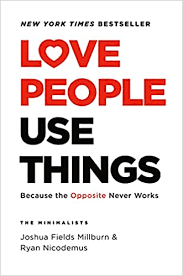
Love People Use Things | The Minimalists

I often don't have time to read many books fully from cover to cover these days. But one book that I just wrapped up (that I started reading back in August!), titled, Love People, Use Things: Because the Opposite Never Works, has had a profound impact on my life. I highly recommend it to others.

Written by childhood friends and business partners Joshua Fields Millburn and Ryan Nicodemus, whom, as a pair, are known as The Minimalists, I bought the book from my local Target store for reading material on my flights to and from Key West this past August. The book had just recently come out a month earlier, back in mid-July 2021. The Minimalists had written a few books before this one, which I have yet to explore. What prompted me to pick this one up, though, was discovering their 2016 documentary, Minimalism: A Documentary About the Important Things, on Netflix. A few days ago, I just watched their most recent film (2021), also available on Netflix, titled, The Minimalists: Less Is Now. I highly recommend both of these documentaries. Very powerful and moving.

In Love People, Use Things, the duo reflect on how reducing all the clutter and noise in our lives - all the junk gathering dust in our closets, basements, and storage units; all the clothes we never seem to get around to wearing; the long hours we're putting in at work and the mounds of debt we're accumulating just to keep up appearances and look "successful" to all our friends, co-workers, neighbors, and even our own family members (The "keeping up with the Joneses" mentality), etc., etc. - can help us live more fulfilling, meaningful, productive lives. By committing to a simpler lifestyle and only holding onto the possessions that truly bring us joy or add value to our lives, we are free to devote more of our energy, time, talents, and other resources to the things that really do matter in life - to hobbies and creative endeavors that bring us joy; to the relationships in our lives; to giving back to others; to making memories through unforgettable experiences. Consuming less liberates us to be able to create more.

The pair reminisce on how they spent their 20s climbing the corporate ladder - at the same company but in different roles and departments - while raking in the dough and owning anything and everything they wanted, only to arrive at the realization that they weren't happy. Both of them grew up poor and in not the best of home/family circumstances, and this is what gave them the drive to push harder and harder for "success." In the end, though, it was all in vain. All they ended up with was the accumulation of stuff, massive credit card debt from acquiring said stuff, and a feeling of emptiness. As Millburn describes it, he was living the American Dream, but it wasn't his dream. In the same month, Millburn lost both his mom (to cancer) and his marriage. It was then that he realized something had to change. He was the first of the duo to stumble upon the philosophy of minimalism, and would later introduce it to childhood friend Nicodemus. Nicodemus noticed his longtime pal seemed happier, and so he took him out to lunch one day at a Subway to get the scoop. The rest, as they say, is history.

You can learn more about Joshua Fields Millburn and Ryan Nicodemus, The Minimalists, at this Wikipedia page dedicated to them. Check out their main website and explore their blog, podcast, and other creative works at TheMinimalists.com.


Search Mr. Robertson's Corner blog